The Complete Guide To Scaling A Business In New Zealand
The Complete Guide To Scaling a Business In New Zealand
For the PDF Version download it by clicking on the photo below:
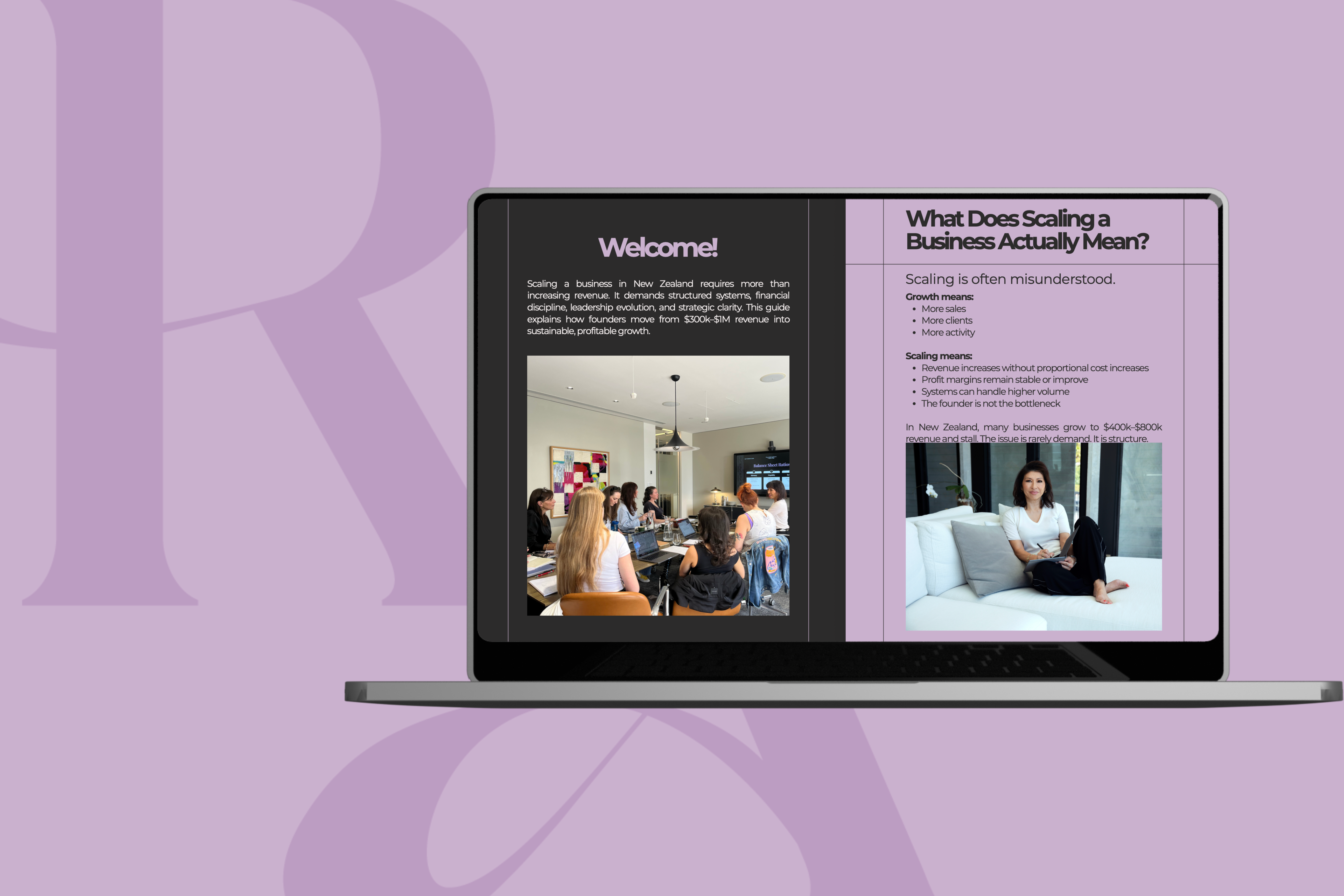
Scaling a business in New Zealand requires more than simply increasing revenue. True scaling happens when a business becomes structured, financially stable, and able to grow without the founder becoming the bottleneck.
Many founders experience strong early growth, but then find their business becomes harder to manage as revenue increases. Teams expand, delivery becomes more complex, and decisions become heavier.
This guide explains how founders move from early growth intosustainable, profitable scaling, supported by stronger systems, clearer financial insight, and more confident leadership.
What Does Scaling a Business Actually Mean?
Scaling is often misunderstood.
Many founders think scaling simply means increasing sales or gaining more clients. While those things represent growth, they are not the same as scaling.
Growth usually means:
More sales
More clients
More activity
More work for the founder
Scaling means something different.
A business is truly scaling when:
Revenue increases without proportional cost increases
Profit margins remain stable or improve
Systems can handle higher client volume
The founder is no longer the operational bottleneck
In New Zealand, many businesses grow successfully to around $400,000–$800,000 in revenue, then stall. The issue is rarely demand. More often, the problem is structure.
The Four Stages of Business Growth in New Zealand
Most businesses move through predictable stages as they grow. Understanding where your business sits can help you focus on the right priorities.
1. Survival Stage ($0 – $250k)
At this stage, the founder does almost everything.
Characteristics often include:
Cash flow can be inconsistent
Pricing may still be reactive
Systems are informal or non-existent
The founder handles most delivery and decision-making
The primary focus in this stage is validating revenue and demand.
2. Stabilisation Stage ($250k – $500k)
The business begins to stabilise but still relies heavily on the founder.
Common characteristics include:
Revenue becomes more predictable
Contractors or early team members may be hired
Profit is often unclear
The founder is frequently overloaded
The focus here should be process documentation and understanding margins.
3. Structured Growth Stage ($500k – $1.5M)
This is where scaling truly begins.
At this point, businesses often experience pressure from increasing complexity.
Typical challenges include:
Growing team responsibilities
More complex client delivery
Important hiring decisions
Leadership strain on the founder
The most important rule in this stage is:
Build systems before expanding the team.
4. Strategic Expansion Stage ($1.5M+)
Businesses entering this stage begin to operate as scalable assets rather than founder-dependent operations.
Characteristics may include:
Multiple revenue streams
A developing leadership team
Investment conversations
More strategic long-term thinking from the founder
The focus shifts from growth alone tob uilding a valuable business asset.
Systems Before Team: The Scaling Rule Most Founders Ignore
Many founders believe hiring will solve operational pressure.
However, hiring into a chaotic business structure often multiplies problems rather than solving them.
Before hiring, founders should first:
Map the client journey from start to finish
Identify repetitive operational tasks
Define clear KPIs for each role
Document standard operating procedures
Clarify who makes which decisions
Automation, process clarity, and structured systems can often delay hiring by 6–12 months, which significantly protects business margins.
Revenue vs Profit: Why Many Businesses Fail to Scale
Revenue growth without margin control creates financial fragility.
Many businesses increase revenue but find they are no more profitable - and sometimes less profitable - than before.
Every founder preparing to scale should clearly understand:
Their gross margin
Their contribution margin
Their cash runway
How much they pay themselves
Whether the business could survive three months of reduced sales
If these answers are unclear, the business is not scaling yet - it is expanding risk.
When Should You Hire in a Scaling Business?
Hiring should happen at the right time and for the right reasons.
Strategic hiring occurs when:
Revenue has been consistent for at least six months
Profit margins comfortably support a salary
The role will increase leverage, not just reduce pressure
Systems and processes already exist to support the role
Warning signs that hiring may be happening too early include:
Feeling overwhelmed but lacking clear structure
Being unable to define the role clearly
Revenue fluctuating heavily
Hoping that hiring will “fix” strategy problems
Scaling requires strategic hires, not emotional ones.
The Founder Identity Shift Required for Scaling
Most business growth plateaus are actually leadership plateaus.
As a business grows beyond $500k–$1M, the founder’s role must evolve significantly.
Founders must shift from:
Operator → Strategic Leader
This shift often requires:
Letting go of daily operational tasks
Making fewer but higher-impact decisions
Increasing financial literacy
Building emotional resilience
Thinking longer-term about business direction
Many founders struggle with this change because their identity has been tied to doing the work.
Scaling requires learning to lead the business rather than run every part of it.
The Unique Reality of Scaling in New Zealand
New Zealand businesses face unique structural conditions compared with larger markets.
These include:
A smaller domestic market
Higher labour costs
Limited local investment pools
Strong community-based networks
Because of this, successful scaling often requires:
Strong margin discipline
Clear market differentiation
Lean team structures
Strategic pricing
Careful hiring decisions
In some industries, international expansion may also become necessary earlier than expected.
The Metrics Every Scaling Founder Must Track
Scaling becomes sustainable only when founders track the right financial indicators.
These metrics determine whether growth is actually healthy.
Gross Margin
The revenue remaining after delivering your product or service.
Gross margin shows whether your pricing and delivery costs support profitable growth.
Net Profit
The amount the business retains after all expenses are paid.
Net profit confirms whether the business is truly making money, rather than simply generating revenue.
Customer Acquisition Cost (CAC)
The cost of acquiring a new customer.
Tracking CAC helps founders understand whether marketing and sales efforts are efficient.
Lifetime Value (LTV)
The total revenue a customer generates throughout their relationship with the business.
This metric reveals whether customers are valuable enough to justify acquisition costs.
Cash Flow Forecast
A forward view of money entering and leaving the business.
Cash flow forecasting prevents financial stress and supports confident planning.
Revenue Per Team Member
Total revenue divided by the number of team members.
This metric helps founders understand whether their team structure is financially productive.
Preparing for Funding or Strategic Investment
Not every business needs outside investment to scale.
However, if funding becomes part of the strategy, investors typically look for several key indicators:
Clear unit economics
A repeatable customer acquisition strategy
Scalable systems
Mature leadership
Financial transparency
Funding amplifies structure - it does not create it.
Common Scaling Mistakes in New Zealand Businesses
Many businesses struggle to scale because of predictable strategic errors.
Common mistakes include:
Hiring before systems are in place
Underpricing due to fear or uncertainty
Confusing revenue growth with profitability
Avoiding financial literacy
Remaining operational instead of becoming strategic
Ignoring leadership development
Avoiding these mistakes dramatically increases the chances of sustainable growth.
What Sustainable Scaling Actually Looks Like
Sustainable scaling rarely looks dramatic or chaotic.
In reality, healthy scaling often looks calm.
Characteristics of a sustainably scaling business include:
Calm decision-making
Predictable revenue
Stable margins
Clear delegation structures
Financial clarity
Founder confidence
It does not look like constant stress or burnout.
Frequently Asked Questions About Scaling
What revenue should a business reach before scaling?
Most New Zealand businesses benefit from reaching consistent revenue above $500k before attempting structured scaling. Below this level, the focus should remain on margin clarity and refining systems.
Is hiring necessary to scale?
Not immediately. Many businesses can increase profitability significantly by improving pricing, operational efficiency, and systems before hiring additional staff.
How long does scaling take?
True scaling often takes two to five years of disciplined operational refinement, leadership development, and strategic decision-making.
Do I need funding to scale?
No. Many New Zealand businesses scale organically. Funding can accelerate growth but also increases financial pressure and expectations.
Final Thoughts
Scaling a business is not about becoming bigger.
It is about becoming stronger.
The businesses that scale successfully in New Zealand are rarely the busiest. Instead, they are the businesses that build structure, clarity, and discipline into how they operate.
With the right systems, financial insight, and leadership development, scaling becomes far more achievable - and far more sustainable.