The Founder Bottleneck Diagnostic
The Founder Bottleneck Diagnostic
A simple check-in to see where your business still depends too heavily on you.
Click on the image below to download the pdf version:
Welcome!
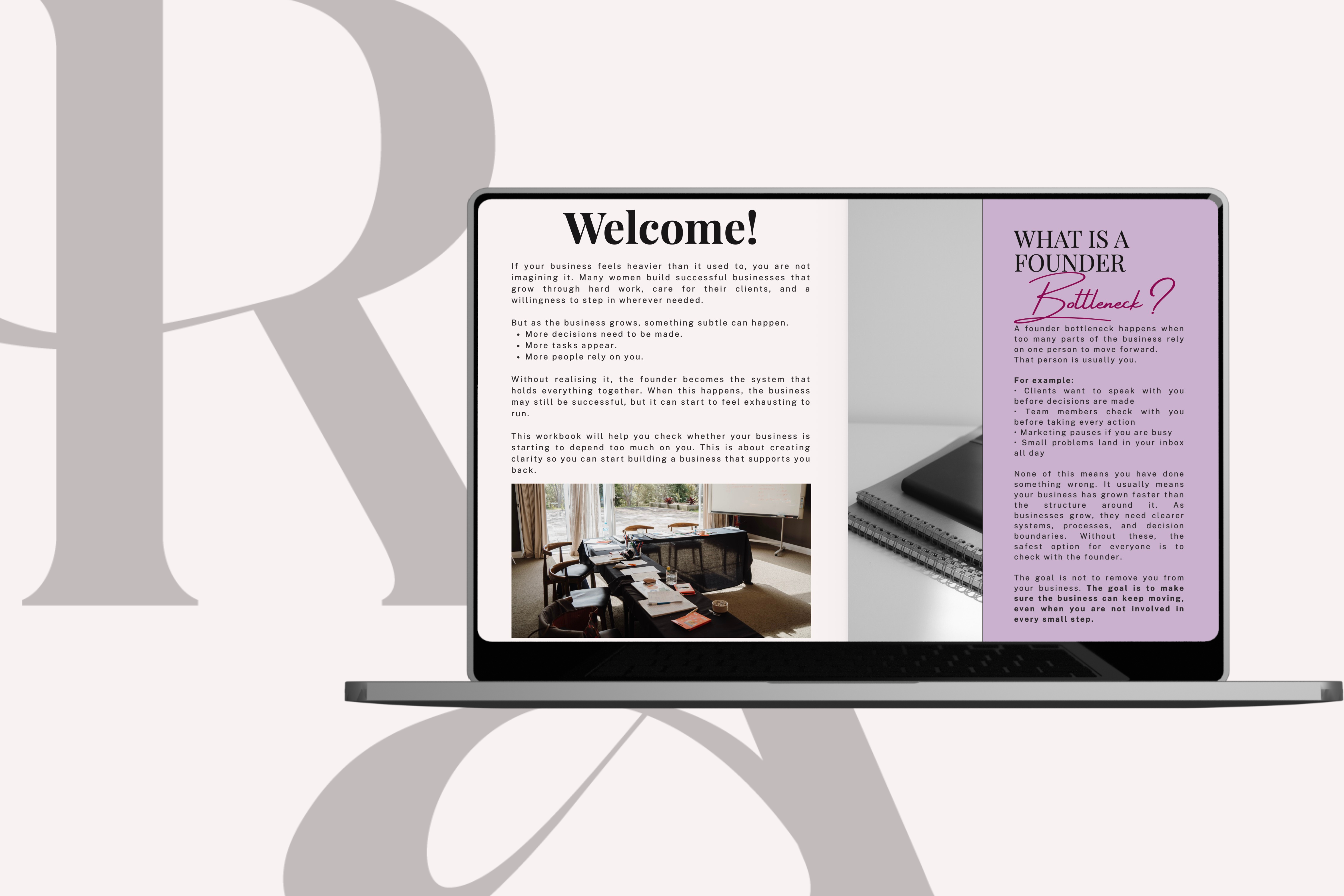
If your business feels heavier than it used to, you are not imagining it. Many women build successful businesses that grow through hard work, care for their clients, and a willingness to step in wherever needed.
But as the business grows, something subtle can happen.
More decisions need to be made.
More tasks appear.
More people rely on you.
Without realising it, the founder becomes the system that holds everything together. When this happens, the business may still be successful, but it can start to feel exhausting to run.
This workbook will help you check whether your business is starting to depend too much on you. This is about creating clarity so you can start building a business that supports you back.
What Is a Founder Bottleneck?
A founder bottleneck happens when too many parts of the business rely on one person to move forward.
That person is usually you.
For example:
Clients want to speak with you before decisions are made
Team members check with you before taking every action
Marketing pauses if you are busy
Small problems land in your inbox all day
None of this means you have done something wrong. It usually means your business has grown faster than the structure around it.
As businesses grow, they need clearer systems, processes, and decision boundaries. Without these, the safest option for everyone is to check with the founder.
The goal is not to remove you from your business. The goal is to make sure the business can keep moving, even when you are not involved in every small step.
A Healthy Business Still Has Questions
In a growing business, it is completely normal for team members to ask questions or check in before making decisions.
Communication helps things run smoothly.
If your team asks for your input, it usually means they care about doing the right thing. The pressure only appears when too many decisions depend on you before work can continue.
This usually happens because:
decision boundaries are not yet clear
processes live in the founder’s head
team members want to avoid making the wrong call
When that happens, work slows down, and the founder becomes the place where everything pauses.
The following diagnostic will help you spot where that might be happening in your business.
How to Use This Diagnostic
For each statement on the following page, tick the answer that feels most true for your business right now.
There are no right or wrong answers.
You are simply looking for patterns.
Use the scale below:
1 – Rarely
2 – Sometimes
3 – Often
4 – Almost always
Section 1
Decision Flow
Reflection prompt:
Where do decisions depend on you the most?
In healthy teams, people can make many day-to-day decisions themselves.
Sometimes, decisions start flowing back to the founder by default.
This section helps you notice whether work can move forward without your approval at every step.
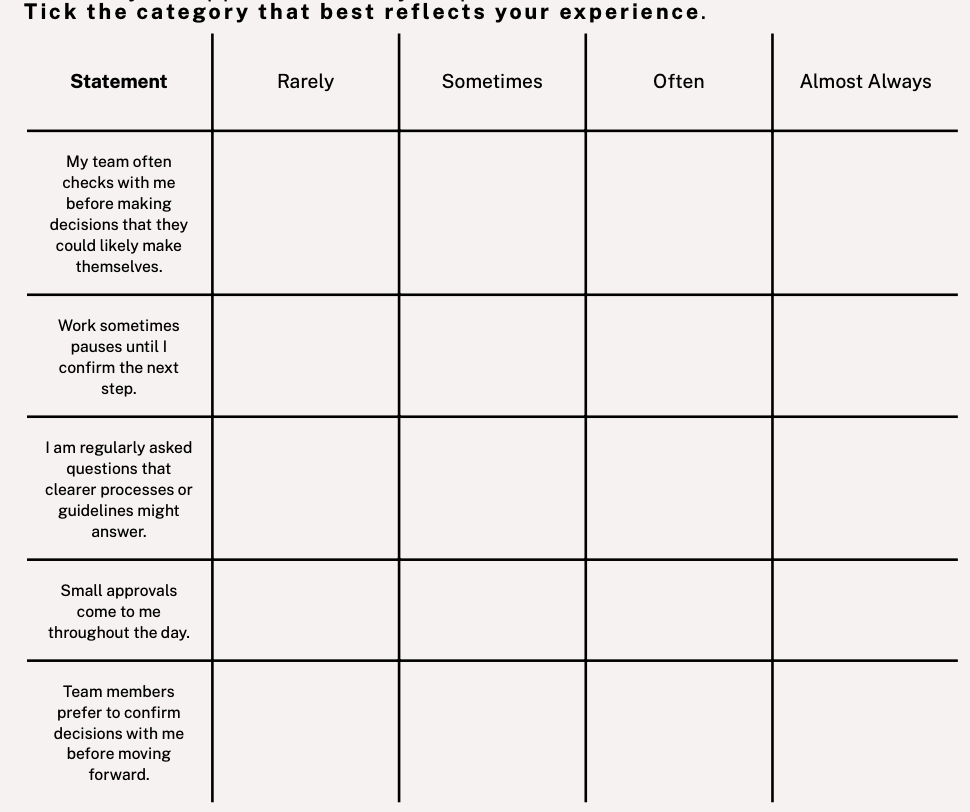
Tick the category that best reflects your experience.
Statements:
My team often checks with me before making decisions that they could likely make themselves.
Work sometimes pauses until I confirm the next step.
I am regularly asked questions that clearer processes or guidelines might answer.
Small approvals come to me throughout the day.
Team members prefer to confirm decisions with me before moving forward.
Section 2
Client Delivery
Reflection prompt:
Which parts of client delivery could someone else support in the future?
Many founders are deeply connected to their client work. That is often part of what made the business successful.
Over time, client delivery can begin to depend heavily on the founder’s presence.
This section helps you notice whether client outcomes rely mostly on you.
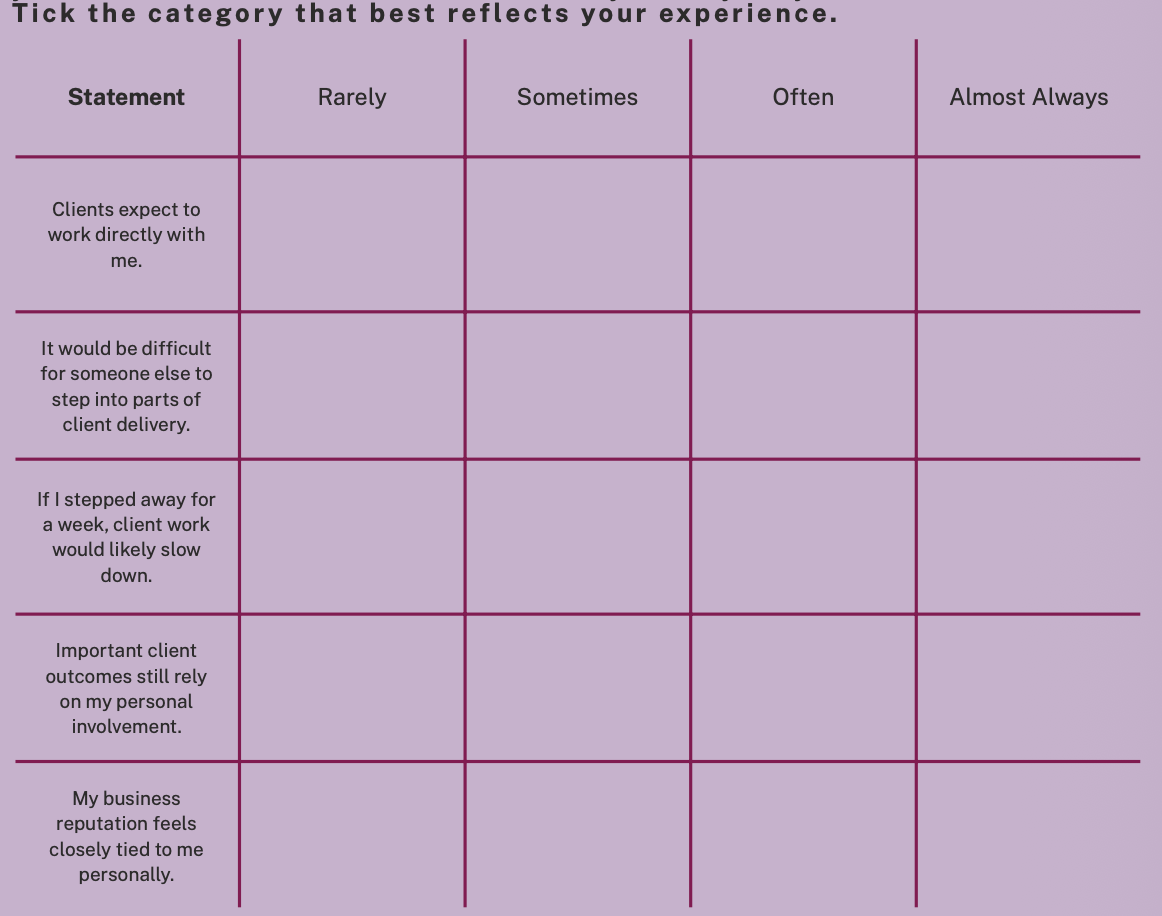
Tick the category that best reflects your experience.
Statements:
Clients expect to work directly with me.
It would be difficult for someone else to step into parts of client delivery.
If I stepped away for a week, client work would likely slow down.
Important client outcomes still rely on my personal involvement.
My business reputation feels closely tied to me personally.
Section 3
Operational Systems
Reflection prompt:
Which processes currently live in your head that could be written down?
Every business runs on systems, even if they are informal.
In early stages, those systems often live inside the founder’s head.
As the business grows, those systems need to become more visible so others can support them.
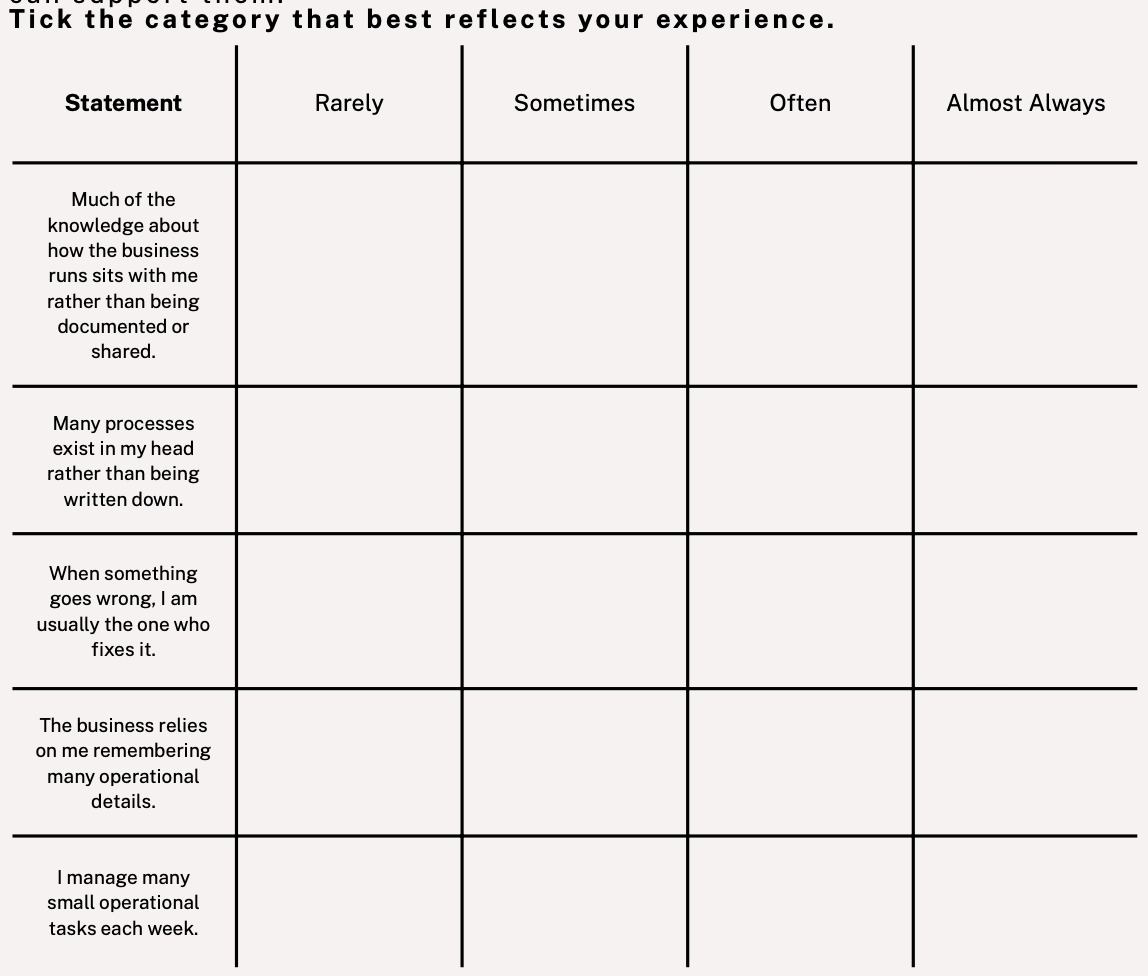
Tick the category that best reflects your experience.
Statements:
Much of the knowledge about how the business runs sits with me rather than being documented or shared.
Many processes exist in my head rather than being written down.
When something goes wrong, I am usually the one who fixes it.
The business relies on me remembering many operational details.
I manage many small operational tasks each week.
Section 4
Time and Energy
Reflection prompt:
Which tasks drain your energy the most each week?
Founders often carry many different roles within their business.
Over time, this can create constant switching between tasks and responsibilities.
This section helps you notice where your time and energy are being pulled.
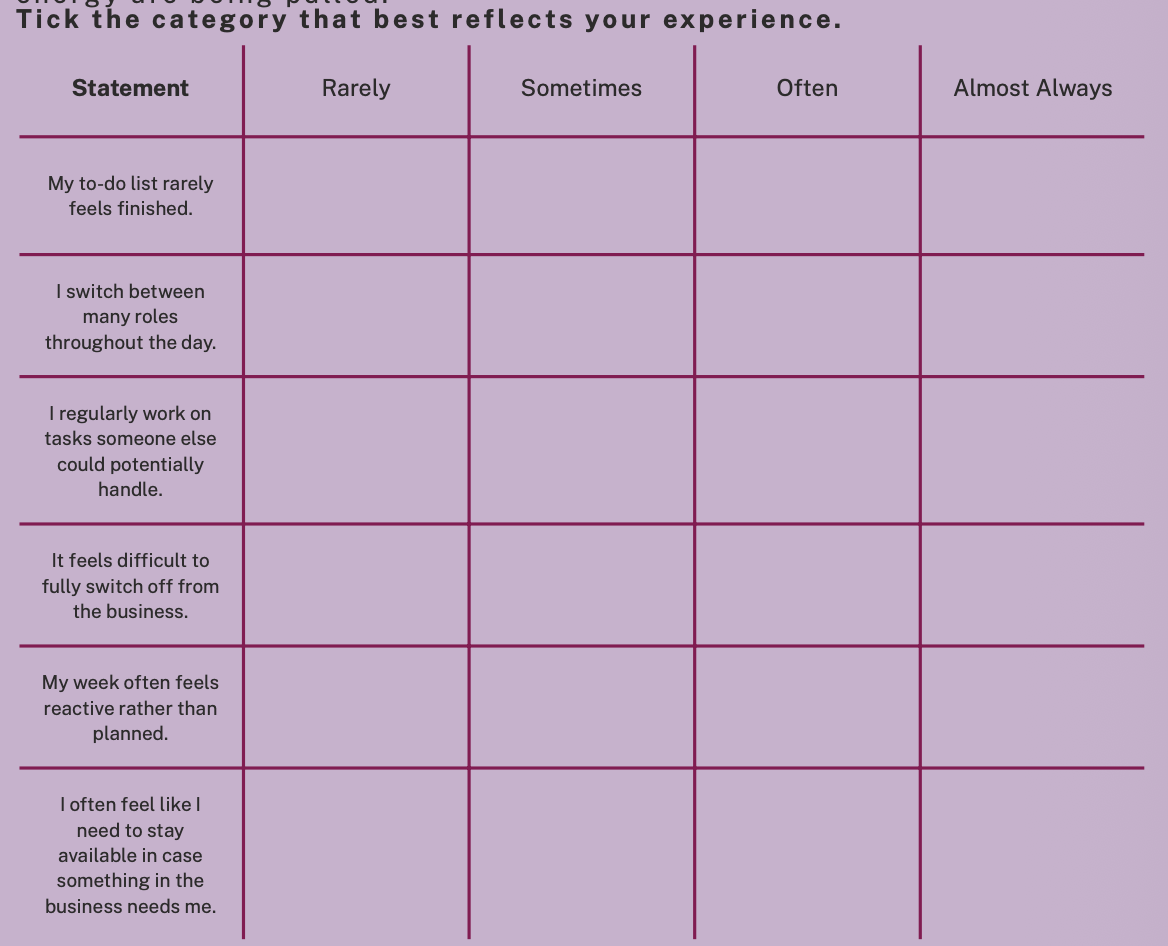
Tick the category that best reflects your experience.
Statements:
My to-do list rarely feels finished.
I switch between many roles throughout the day.
I regularly work on tasks someone else could potentially handle.
It feels difficult to fully switch off from the business.
My week often feels reactive rather than planned.
I often feel like I need to stay available in case something in the business needs me.
Your Results
Look back over your answers.
Notice which section felt most true for your business.
This does not mean anything has gone wrong.
It simply shows where your business may be ready for its next layer of structure.
That might include:
clearer systems
documented processes
shared responsibilities
clearer decision boundaries
Reflection Prompt
Which section stood out most for you?
Decision Flow
Client Delivery
Operations
Time and Energy
Why?
Your First Step Forward
You do not need to change everything at once.
Progress usually starts with improving one area of the business.
Reflection Prompts
If you could remove pressure from one area over the next quarter, what would it be?
What is one small change that could help?
Examples might include:
documenting a repeatable process
training someone in a task
introducing a new system
clarifying who makes certain decisions
A Final Thought
If your business still depends heavily on you, it does not mean you built it the wrong way.
It usually means your business has outgrown its original structure.
With clearer systems and support, the business can keep growing without relying on you for every step.
And that is when running your business starts to feel manageable again.
With gratitude,
Marisa xx