Understanding ROAS
UNDERSTANDING ROAS
How to Know if Your Paid Marketing is Actually Working
A Step-by-Step Workbook for Women In Business
Click on the image below to download the pdf version:
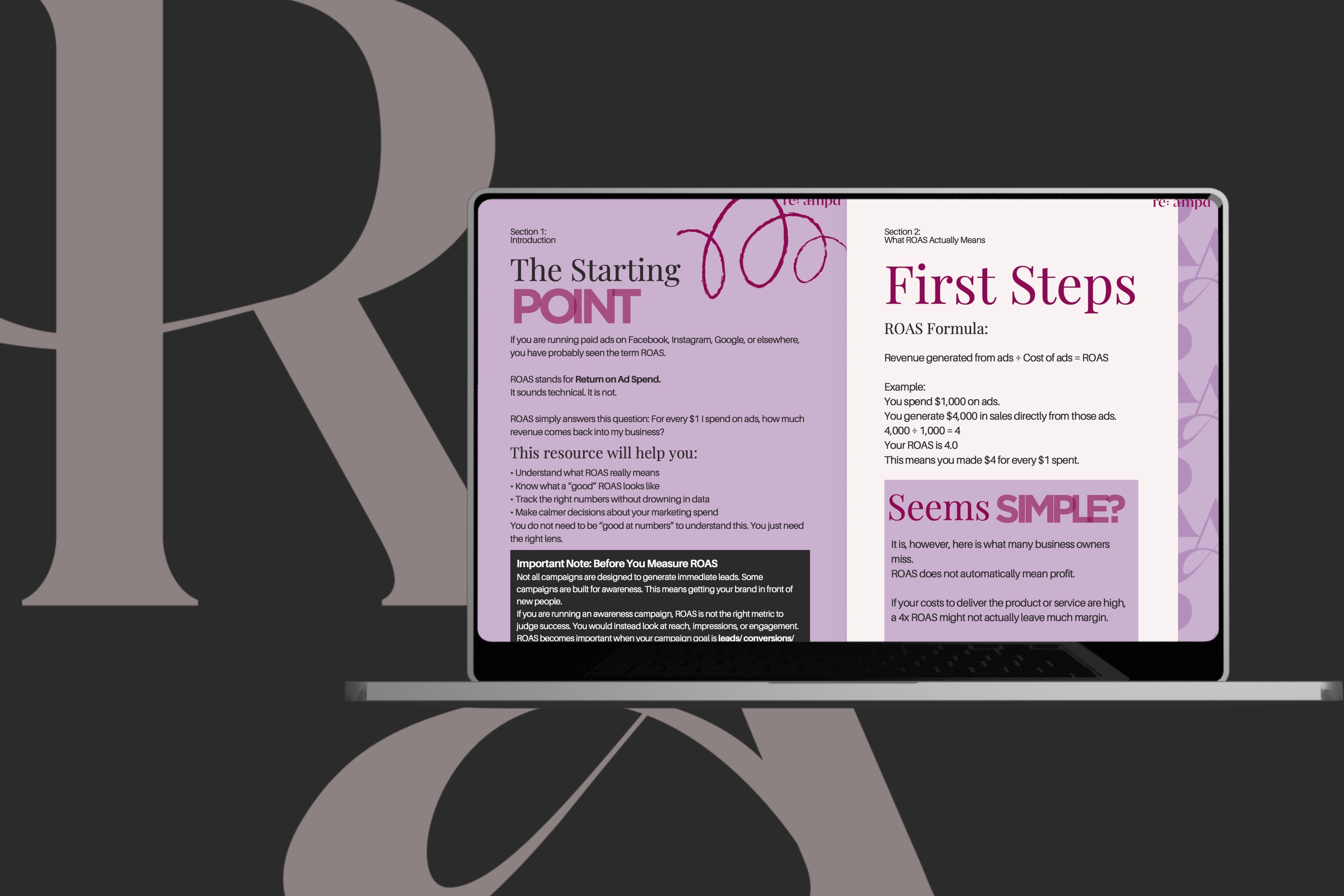
Section 1: Introduction
The Starting Point
If you are running paid ads on Facebook, Instagram, Google, or elsewhere, you have probably seen the term ROAS.
ROAS stands for Return on Ad Spend.
It sounds technical. It is not.
ROAS simply answers this question:
For every $1 I spend on ads, how much revenue comes back into my business?
This resource will help you:
Understand what ROAS really means
Know what a “good” ROAS looks like
Track the right numbers without drowning in data
Make calmer decisions about your marketing spend
You do not need to be “good at numbers” to understand this. You just need the right lens.
Important Note: Before You Measure ROAS
Not all campaigns are designed to generate immediate leads. Some campaigns are built for awareness. This means getting your brand in front of new people.
If you are running an awareness campaign, ROAS is not the right metric to judge success. You would instead look at reach, impressions, or engagement.
ROAS becomes important when your campaign goal is leads/conversions/sales.
If you are asking people to book a call or purchase a product/service, then measuring return on ad spend matters.
The key is matching the metric to the intention of the campaign.
Section 2: What ROAS Actually Means
First Steps
ROAS Formula
Revenue generated from ads ÷ Cost of ads = ROAS
Example:
You spend $1,000 on ads.
You generate $4,000 in sales directly from those ads.
4,000 ÷ 1,000 = 4
Your ROAS is 4.0
This means you made $4 for every $1 spent.
Seems SIMPLE?
It is, however, here is what many business owners miss.
ROAS does not automatically mean profit.
If your costs to deliver the product or service are high, a 4x ROAS might not actually leave much margin.
Which is why ROAS should never be looked at in isolation.
Section 3: Metrics
The Key Metrics That Actually MATTER
When members log into their ad platform, they see dozens of numbers. Most are distractions.
Here are the metrics that matter most:
N.1 Cost Per Click (CPC)
How much you pay each time someone clicks your ad. If this is high, your targeting or messaging may need adjusting.
N.2 Conversion Rate
The percentage of people who take the desired action after clicking.
For example:
100 people click, 5 buy.
That is a 5 percent conversion rate.
If your conversion rate is low, the issue is usually the landing page or offer, not the ad.
N.3 Cost Per Acquisition (CPA)
How much it costs to acquire one paying customer.
Example:
Spend $1,000 and make 10 sales.
Your CPA is $100.
This shows the true cost of turning interest into revenue.
N.4 Cost Per Lead (CPL)
How much it costs to generate one contact (a booked call or enquiry).
Example:
Spend $1,000 and get 40 contacts.
Your Cost Per Contact is $25.
This shows how efficiently your ads generate interest.
N.5 Revenue Per Sale
The average value of each purchase.
If this increases, ROAS improves without spending more on ads.
N.6 Overall ROAS
The big picture number.
This tells you efficiency, not sustainability.
Section 4: What Is a “Good” ROAS?
There is no universal answer.
It depends on:
Your profit margins
Whether you are selling a one-off offer or building lifetime value
Whether this is a growth phase or stability phase
As a general guide:
2x ROAS can work for high-ticket services with strong backend sales.
3x–4x is often considered healthy for many businesses.
5x+ is strong if margins support it.
But the real question is:
Does this campaign create profitable growth for your business?
That is what matters.
Section 5: Common Patterns We Notice
The Mistakes We See Most Often
N.1 Looking at ROAS Daily
Ad performance fluctuates. Look weekly at minimum.
N.2 Scaling too quickly
If something works, increase budget slowly. Not overnight.
N.3 Ignoring profit margins
Revenue is not the same as profit.
N.4 Expecting ads to fix a weak offer
Ads amplify what already exists. They do not repair broken positioning.
Section 6: How ROAS Is Tracked (In Simple Terms)
Pixels + Tracking
For ROAS to be accurate, your ad platform needs to see what happens after someone clicks your ad. This is where a pixel comes in.
What Is a Pixel?
A pixel is a small piece of tracking code added to your website. You and your customers do not see it.
Its job is simple. It tells the ad platform when someone:
Visits your website
Fills out a form
Makes a purchase
In short, it connects the actions tracked back to the ad.
Without a pixel, ROAS cannot be calculated accurately.
Why This Matters
If tracking is not set up correctly, you can end up:
Undertracking:
The platform shows fewer conversions/leads than actually occurred.
Over-tracking:
The platform shows more conversions than actually occurred.
Both lead to poor decisions.
Before reviewing ROAS each month, check:
Is my pixel installed on all key pages?
Do my ad platform numbers roughly match my actual sales figures?
Am I reviewing GST exclusive numbers for clarity?
Use the built-in testing tools available in your ad platform to check your tracking is working properly. For example, Meta has its own Pixel testing tool that lets you see if events like purchases or leads are firing correctly.
You do not need to be technical; you just need to make sure the numbers make sense.
When tracking is clean, your decisions become much more confident.
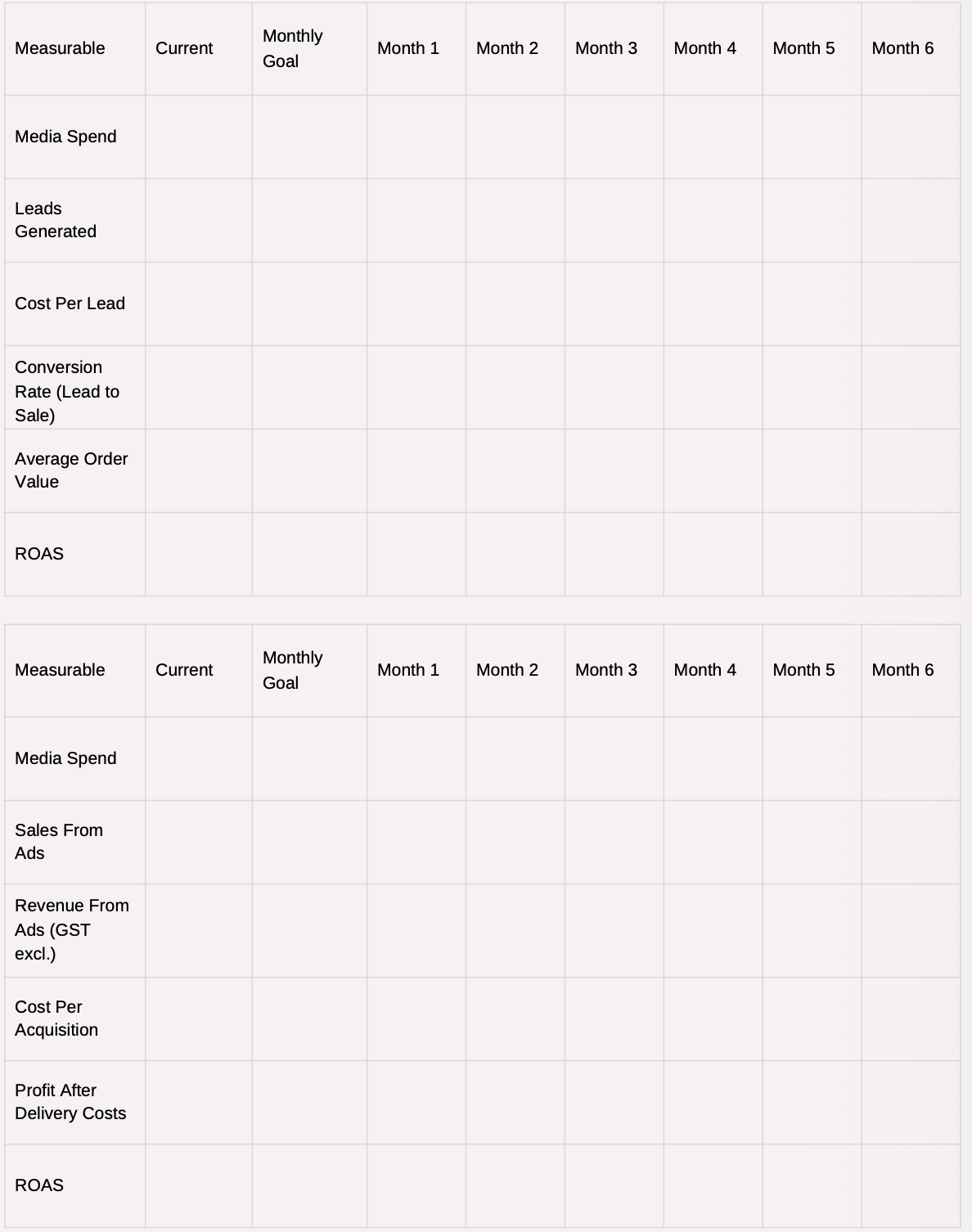
Section 7: Your 6 Month Marketing Scorecards
A Simple Monthly Check-In Process
Not every lead becomes a sale. Because of that, we measure two stages of performance:
Lead Efficiency– How effectively your ads generate interest at the right cost.
Sales & Profitability– How well those leads convert into revenue and return.
Together, these two views give you clarity.
Update both once per month. Not weekly.
You are looking for trends, not daily fluctuations.
Scorecard 1: Lead Performance
This scorecard focuses on lead generation.
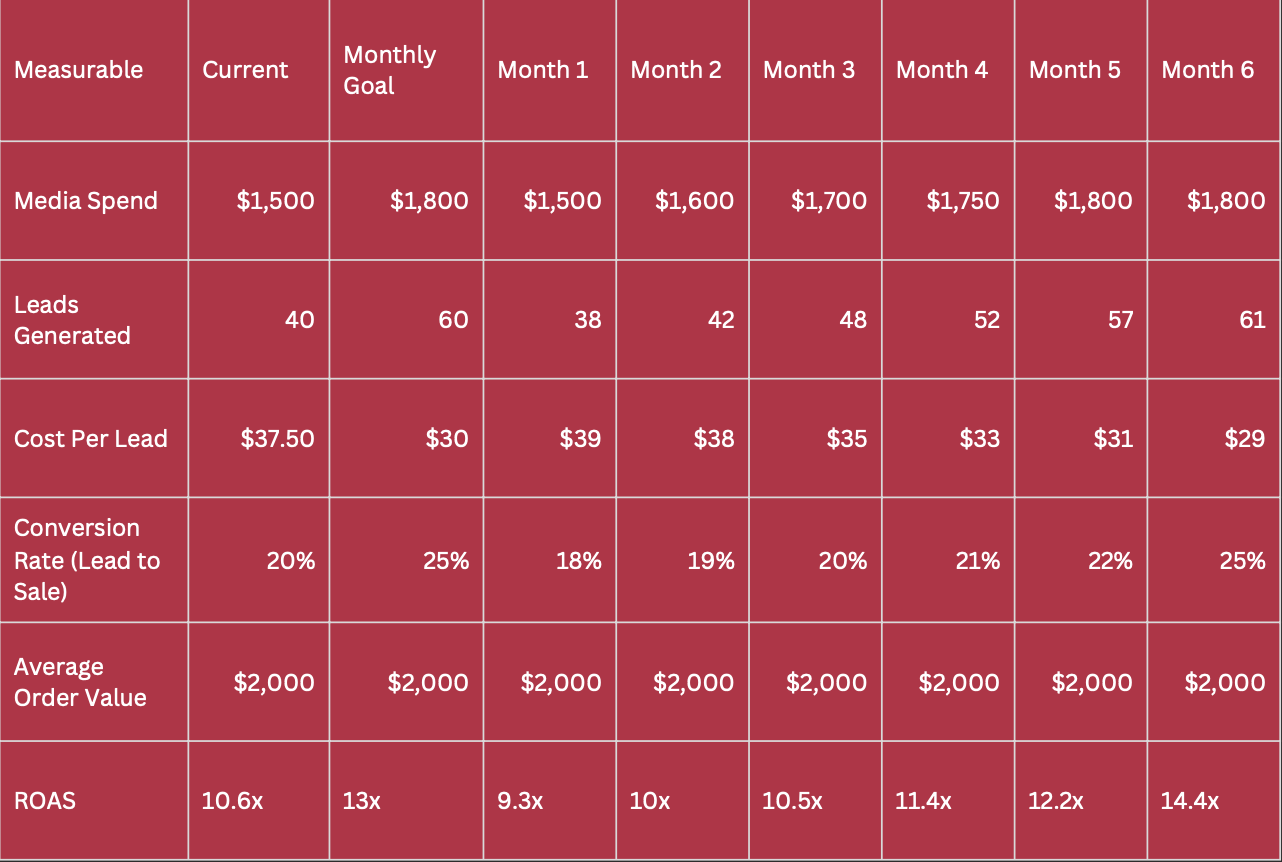
What Each Measurable Means
Media Spend
The total amount you spent on paid ads for that month.
Leads Generated
The number of people who booked a call, downloaded something, or enquired because of your ads.
Cost Per Lead
Media Spend divided by Leads Generated. This shows how much you are paying for each enquiry.
Conversion Rate (Lead to Sale)
The percentage of leads that become paying clients.
For example, if you had 40 leads and 8 sales, your conversion rate is 20%.
This tells you how effective your sales process is.
Average Order Value
The average amount each customer spends.
If you made $20,000 from 10 sales, your average order value is $2,000.
ROAS (Return on Ad Spend)
Revenue from ads divided by Media Spend.
This shows how many dollars are generated for every $1 spent on ads.
Scorecard 2: Sales & Revenue Performance
This scorecard focuses on profitability and scale.
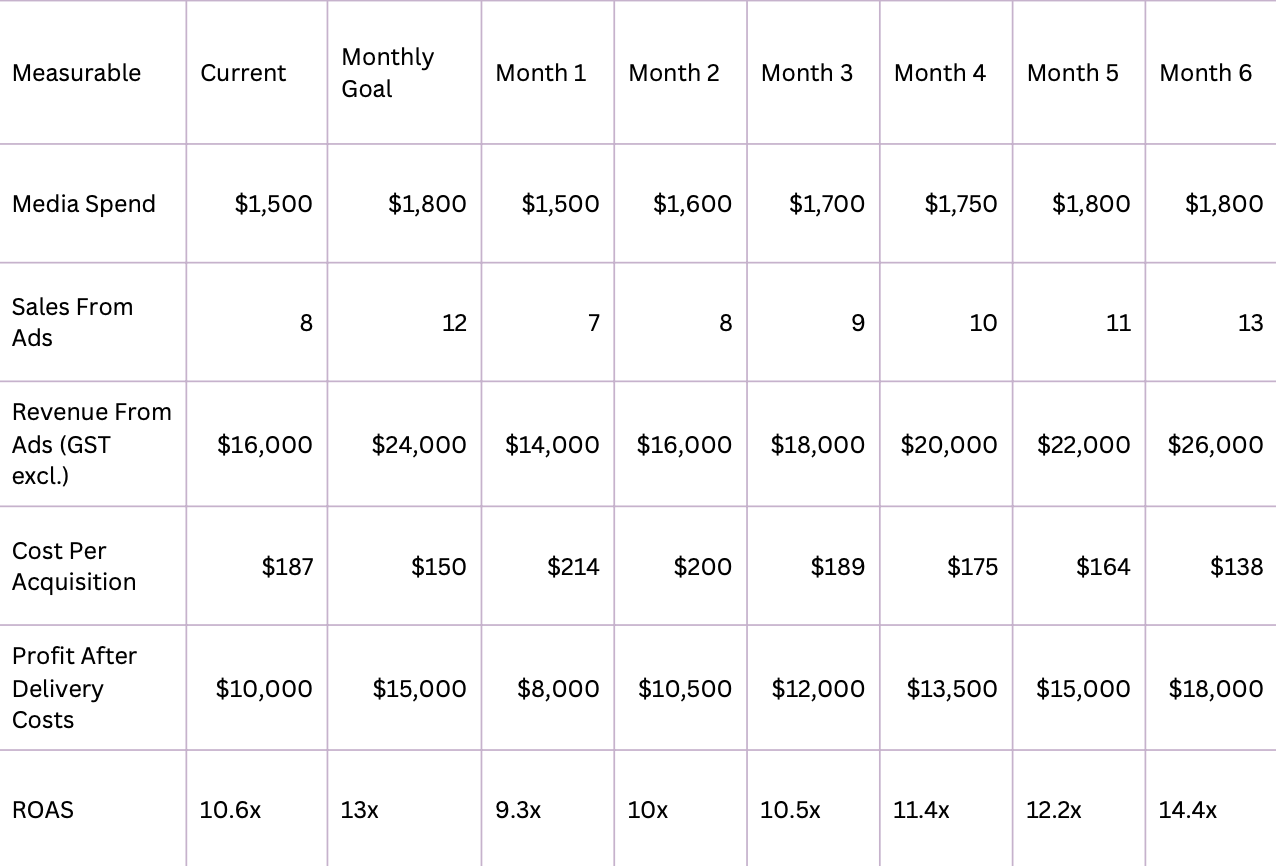
What Each Measurable Means
Media Spend
The total amount spent on ads that month.
Sales From Ads
The number of confirmed purchases that came directly from your paid campaigns.
Revenue From Ads (GST exclusive)
The total sales revenue generated from those ads.
If you are GST registered, use GST exclusive figures so your numbers are accurate.
Cost Per Acquisition
Media Spend divided by number of sales.
This shows how much it costs to acquire one paying customer.
Profit After Delivery Costs
Revenue minus the direct costs required to deliver your product or service.
This could include contractor payments, software used to deliver the service, or product costs.
ROAS
Revenue divided by Media Spend.
This measures efficiency. Not profit, but return.
Your Lead Performance Scorecard
After recording your numbers, review:
Scalable
If ad spend increases, do conversions increase too?
Sustainable
Are margins protected after GST and delivery costs?
Stable
Are results consistent month to month?
If not, adjust the structure before increasing spend.
NZ Context Note
Remember to factor in GST when calculating revenue and costs.
If you are GST registered, compare GST-exclusive figures to keep your numbers clear.
Example:
If you charge $1,150 including GST, your actual revenue is $1,000.
Clarity here matters.
Final Thoughts
Paid marketing should feel strategic, not stressful.
When you understand what to measure, decisions become clearer.
ROAS is not about chasing bigger numbers; it is about making confident, informed choices.
You do not need to be a data expert.
You just need to understand the story your numbers are telling you.
And that is something you can absolutely learn.
With gratitude,
Marisa xx